Maintenance
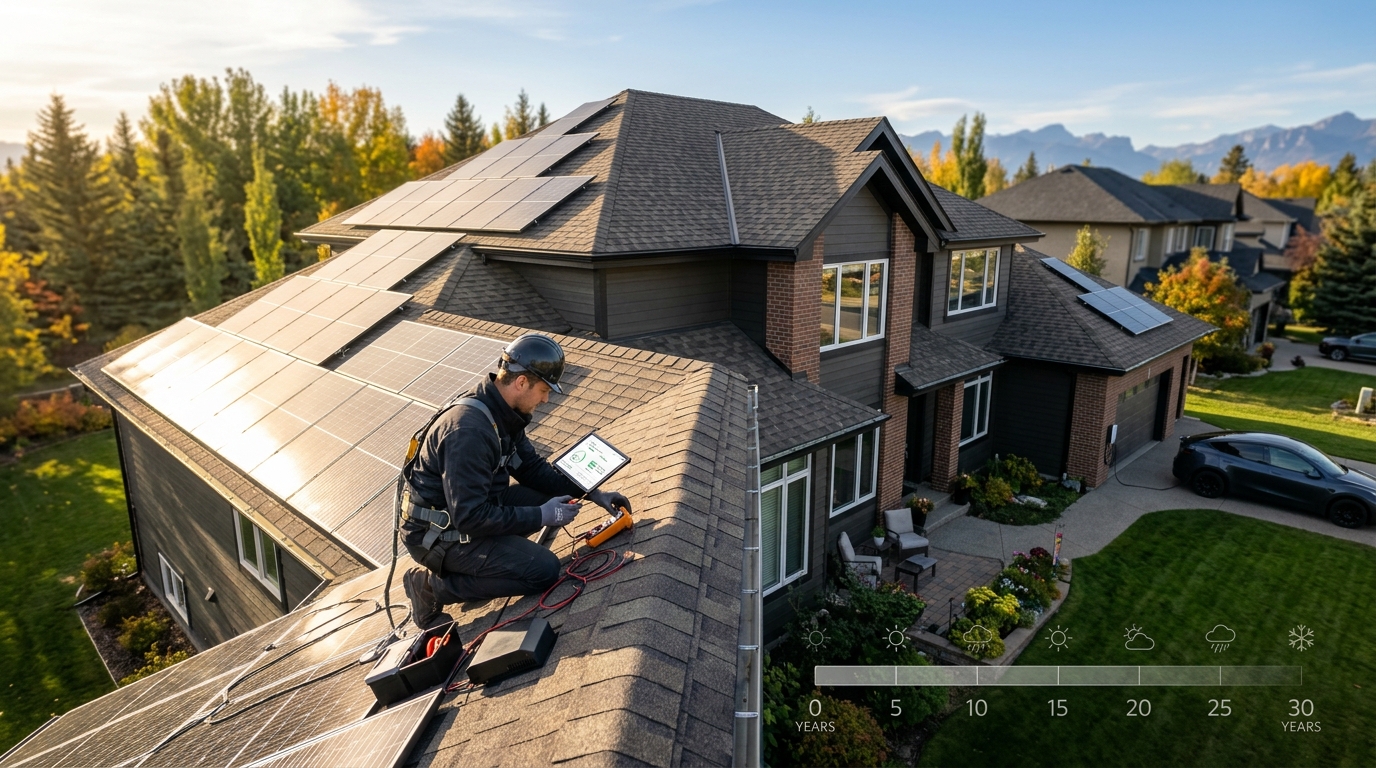
The warranty says 30 years. The real answer is longer — and the maintenance required is far simpler than most homeowners expect.
When you're committing $20,000–$30,000 to a solar installation in Alberta, one of the most important questions you can ask is: how long will this actually last? Not the marketing answer. The real answer.
The good news is that modern solar panels are among the most durable consumer products ever manufactured. They have no moving parts, require minimal intervention, and continue generating electricity well past their warranty periods. But they do degrade slowly over time, the other components in your system have different lifespans, and there are a handful of Calgary-specific maintenance considerations that every Alberta homeowner should understand.
This guide covers the real lifespan data, the degradation math, what your system's components need over 30+ years, and what to expect when your panels approach end-of-warranty age.
The standard answer is 30 years — the length of most manufacturer performance warranties. But that framing is misleading because panels don't stop working at year 30. They continue producing electricity; they just produce slightly less each year as they age.
According to NREL (National Renewable Energy Laboratory), which has studied the degradation rates of nearly 2,000 solar systems worldwide, modern monocrystalline panels manufactured after 2000 degrade at a median rate of approximately 0.5% per year — and in many cases, even less.
Real-world evidence supports the longer end of the lifespan range. One of the oldest solar systems in the world operated in Italy from 1982 to 2017 with minimal interruption. Individual panels from the 1980s have been tested and found to have lost only 8% of their output after 40 years in service. Modern panels with improved materials are expected to perform even better.
The practical lifespan for a well-installed Alberta solar system: 30–40 years. The warranty is the floor, not the ceiling.
Degradation is the gradual, predictable decline in a panel's electrical output over time. It's not damage — it's normal aging of the photovoltaic cells caused by prolonged UV exposure, thermal cycling, and minor material changes.
At 0.5% annual degradation:
| Year | Output as % of Original | Example: 8 kW System Annual Production |
|---|---|---|
| Year 1 | 100% | 10,200 kWh |
| Year 5 | 97.5% | 9,945 kWh |
| Year 10 | 95.1% | 9,700 kWh |
| Year 15 | 92.7% | 9,455 kWh |
| Year 20 | 90.5% | 9,230 kWh |
| Year 30 | 86.1% | 8,785 kWh |
After 30 years, your 8 kW system still produces roughly 8,800 kWh/year — about 86% of its original output, and well within the 80% minimum the manufacturer's performance warranty guarantees. The system has paid itself back years ago, and is now generating free electricity from a fully depreciated asset.
Premium panels perform even better. Tier 1 manufacturers like REC, LONGi, and Canadian Solar increasingly offer panels rated for 0.25–0.3% annual degradation. At 0.3% degradation, a panel at year 30 still produces 91.4% of original output — essentially the same system you installed.
Understanding your warranties is essential for protecting your investment over a multi-decade ownership period. Three distinct warranties apply:
Covers manufacturing defects, delamination, frame failures, and physical problems with the panel itself. If a panel develops a fault that isn't caused by external damage, the manufacturer replaces it. Most Tier 1 manufacturers offer 30-year product warranties in 2026.
Important: Product warranties typically do not cover labour, shipping, or damage from external causes (hail, storm damage, improper installation). Read the fine print before choosing a panel brand.
Guarantees minimum output at specific milestones — typically 90% at year 10 and 80% at year 30. This is the warranty that protects you against unusually rapid degradation.
If your panels are producing significantly less than the warranted output, the manufacturer is obligated to compensate — either by repairing, replacing, or providing a cash settlement. To make a claim, you'll need documented production data from your monitoring system, which is another reason to keep monitoring active throughout the system's life.
Covers the quality of installation: roof penetration sealing, cable management, racking attachment, and electrical connections. This is the warranty that disappears if your installer goes out of business — which is why choosing a stable, established Calgary installer is so important.
Installation quality is arguably the biggest variable in real-world panel lifespan. Roof penetrations that are not properly flashed can allow moisture into electrical connections, accelerating corrosion that can shorten productive life by 5 years or more.
Solar panels are the long-lived component in your system. The other parts have shorter service lives and will need attention during a 30-year ownership period.
The string inverter is the electronic component most likely to need replacing during your system's life. Budget for one or two replacements over a 30-year system life.
Replacement cost in Calgary (2026): $1,500–$3,000 installed, depending on system size and brand. String inverters should be replaced proactively when they approach the end of their rated life (around year 10–12), not after failure.
Microinverters run cooler than string inverters and typically carry 30-year warranties from Enphase and APSystems. A single microinverter replacement costs $150–$300 installed.
Aluminum racking is extremely durable and essentially maintenance-free in normal conditions. Inspect annually for loose bolts, corrosion at roof penetration points, and adequate critter guards.
UV-rated MC4 weatherproof cables used on modern installations are rated for 30+ years. Rodent damage is the most common wiring issue in Calgary — critter guards installed at installation are the best prevention.
The monitoring gateway is consumer electronics and has the shortest lifespan of any system component. Expect to replace it once during the system's life. Cost is typically $150–$400.
Calgary's dry, powdery snow and the panel angles used in most installations mean snow typically clears itself within 1–3 days. Natural clearing is generally the right approach — the risks of climbing on a snowy or icy roof outweigh the benefit of 1–2 days of additional production.
For accessible ground-mounted or low-pitch systems, a soft-bristle extension brush can safely clear panels from ground level. Do not use hot water on cold panels — the thermal shock can crack the glass.
Calgary sits in Canada's hail belt. Well-specified panels (IEC 61215-certified) are tested to withstand 25mm hailstones at 80 km/h. After any major hailstorm, inspect your panels visually and check your monitoring data for any production drop. Most home insurance policies in Alberta cover solar panels as part of the home's structure.
In most cases, natural rainfall is sufficient to keep panels clean. If you notice a persistent production drop during a dry spell, a gentle rinse with a garden hose is usually enough. For high or steeply-pitched roofs, professional cleaning services cost approximately $150–$300 for a typical residential system.
A professional inspection every 3–5 years is worth the cost for the peace of mind and the warranty documentation it provides.
Modern solar monitoring apps (Enphase Enlighten, SolarEdge monitoring, APSystems EMA, and others) are among the most underutilized tools in residential solar ownership.
What to watch for in your monitoring data:
If any of these patterns appear, contact your installer's service team.
When your performance warranty expires, three things are true:
Keep running as-is: If production is within 85–90% of original and there are no component failures, the economically rational choice is usually to keep the system running.
Replace the inverter: A new inverter for $1,500–$3,000 extends the system's productive life by another 10–15 years.
Upgrade or expand: At year 30, it may be economically attractive to replace aging panels with new, higher-efficiency models on the same racking.
The typical asphalt shingle roof lasts 20–30 years. Solar panels last 30–40 years. Removing and reinstalling solar panels for a roof replacement costs $1,500–$3,000 in Calgary. If your roof is 10–15 years old when you install solar, seriously consider replacing the roof first or simultaneously.
A quality solar installation in Calgary, properly specified with Tier 1 hail-rated panels and installed by a licensed team, is genuinely a low-maintenance 30–40 year asset. The main tasks across that ownership period are:
Your panels will almost certainly outlast your mortgage, possibly your roof, and very likely several models of the car in your driveway. Plan accordingly.
Last updated: June 2026. Warranty terms, component lifespans, and maintenance costs vary by manufacturer and installer. Always verify current warranty documentation with your installer and equipment manufacturers.
There are strong programs and financing options that can make going solar more affordable — with no money up front to get started, if you qualify.
If you qualify. See Alberta solar incentives →